8 Key Differences Between Kosher Salt and Canning Salt
Are you often confused about which salt to use in your recipes? You’re not alone—many home cooks struggle with choosing the right type of salt for different tasks.
Using the wrong salt can affect flavor, texture, and even preservation. That’s why understanding the key differences between kosher salt and canning salt is so helpful.
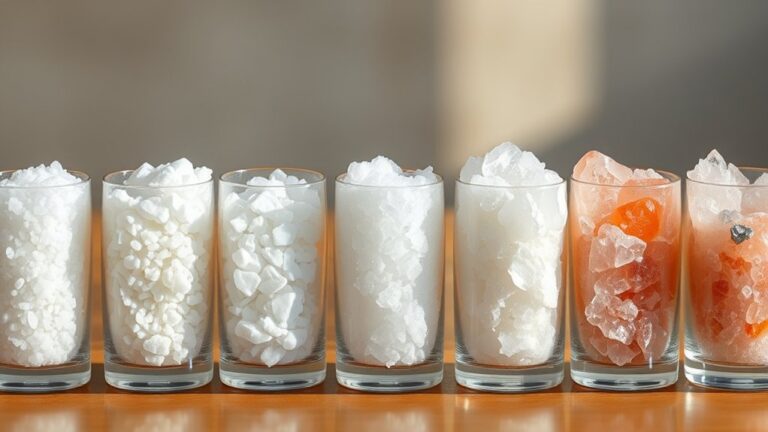
Kosher salt has large, flaky grains with irregular shapes, making it ideal for seasoning and drawing out blood from meat.
Canning salt has small, uniform cubic crystals designed for preservation and quick dissolving. They differ in texture, flavor, and best uses—kosher salt for cooking and finishing, and canning salt for pickling.
Both are safe but require adjustments when swapping. To learn more about when and how to use each, keep exploring these key differences.
Key Takeaways
- Kosher salt has large, flaky crystals that are great for seasoning. Canning salt, on the other hand, has fine, cubic crystals that are perfect for preservation.
- The crystals in kosher salt are irregular and tend to dissolve slowly. Canning salt’s uniform crystals dissolve quickly, helping to distribute brine evenly.
- Canning salt is pure and doesn’t contain any anti-caking agents. Kosher salt may sometimes have additives, so it’s good to check the label.
- Kosher salt offers a milder, mineral-rich flavor that enhances dishes without overpowering them. Canning salt provides a neutral, salty taste right away.
- When substituting canning salt for kosher salt, use less. This is because canning salt is finer and has a higher saltiness concentration.
What Are Kosher Salt and Canning Salt?
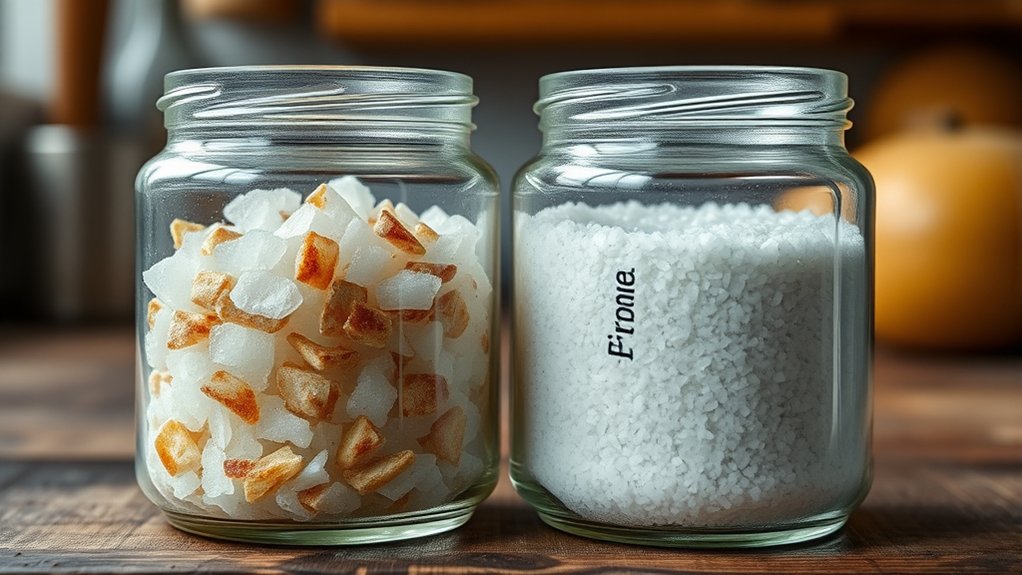
Kosher salt and canning salt are two common types of salt used in cooking and food preservation, but they differ a lot in their composition and purpose.
Kosher salt is a coarse-grained salt favored for its ability to draw out blood from meat and for being easy to handle in the kitchen. It’s usually free of additives and has a flaky, chunky texture.
Kosher salt’s coarse grains make it ideal for drawing out blood and easy handling in the kitchen.
Canning salt, on the other hand, is specifically designed for preserving foods through canning. It’s fine-grained and pure, often free of anti-caking agents so it dissolves easily during processing.
While both are used in food prep, their differences in purity and grain size reflect their roles: kosher salt for seasoning and handling, and canning salt for accurate, preservative purposes.
How Do Their Textures and Grain Sizes Differ?
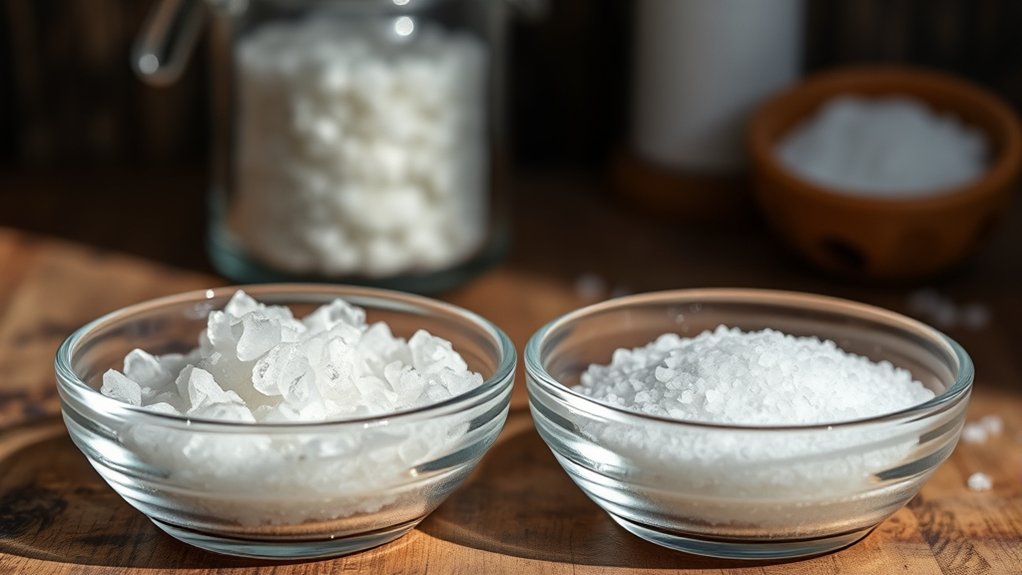
You’ll notice that kosher salt has larger, coarser grains compared to the finer, more uniform crystals of canning salt.
The crystal structures also differ, which affects how quickly each dissolves in water or food.
These differences influence not just texture but also how each salt interacts during cooking and preservation.
Crystal Structure Variations
The crystal structures of kosher salt and canning salt are quite different, which affects their textures and grain sizes. Kosher salt usually forms larger, more irregular crystals with a flaky or blocky shape, making it easy to pinch and spread.
Its crystals aren’t packed tightly, so it has a light, coarse texture. Canning salt, on the other hand, has a more uniform, cubic crystal structure that packs tightly.
These smaller, regular crystals give it a finer, denser feel. The way their crystals are arranged impacts how each salt dissolves and how it feels when you handle it.
Kosher salt’s irregular shape and bigger crystals give it a distinctive texture. In contrast, canning salt’s compact, uniform crystals make it feel smoother and more consistent.
Grain Size Differences
Because of their distinct crystal structures, kosher salt and canning salt also differ greatly in grain size and texture. Kosher salt has larger, coarser grains that feel flaky and light, making it easy to pinch and sprinkle evenly over food. Its irregular crystals create a rougher texture, which helps it dissolve slowly.
Canning salt, on the other hand, has much smaller, finer grains that are densely packed. This fine texture allows it to dissolve quickly in liquids and distribute evenly, which is essential for precise canning recipes. The difference in grain size affects how you measure each salt—coarse kosher salt often needs to be packed or measured by volume, while fine canning salt can be easily weighed or measured by volume.
Texture and Dissolution
The texture and grain size of kosher salt and canning salt directly influence how they dissolve in food or liquids. Kosher salt usually has larger, coarser grains, which dissolve more slowly and give a noticeable crunch when used as a finishing salt.
Canning salt, on the other hand, has finer grains that dissolve quickly, making it perfect for homogeneous mixtures like brines and pickling solutions. When cooking, you’ll see kosher salt takes longer to fully incorporate, giving you more control over seasoning.
Conversely, canning salt dissolves fast, ensuring even distribution without leftover grains. This difference affects both the texture of your dishes and how precisely you can season or preserve foods.
Understanding these dissolution properties helps you pick the right salt for each culinary task.
Why Do They Have Different Uses in Cooking and Preserving?
You’ll notice that kosher salt and canning salt have different qualities that make them suited for specific purposes. Their varying preservation methods and textures influence how they’re used in cooking and preserving.
Understanding these differences helps you choose the right salt for each task. It’s all about using the best type for what you’re trying to achieve in your kitchen.
Different Salt Qualities
Different salts vary quite a bit in texture, mineral content, and granule size, which affects how they’re used in cooking and preservation.
For example, kosher salt has larger, coarse grains that are easy to pinch and sprinkle evenly. It’s great for seasoning meats and vegetables. Its low mineral content and flaky structure help it dissolve quickly, boosting flavor without clumping.
Canning salt, on the other hand, is fine-grained and pure, with no additives. It’s perfect for preserving foods where uniformity and clarity matter. Its fine texture ensures even distribution in pickling brines.
These differences in salt qualities impact how each type interacts with food, influencing flavor, texture, and how well it preserves. Choosing the right salt for your task helps ensure the best results in both cooking and preserving.
Varying Preservation Methods
Salt’s physical qualities directly influence how it’s used in cooking and preservation. Kosher salt’s large, flaky crystals make it easy to sprinkle and control during both processes.
Its coarse texture allows it to dissolve slowly, making it ideal for drawing out moisture in curing meats and pickling. Canning salt, on the other hand, is fine and uniform, ensuring even dissolving and consistent results in preserving fruits, vegetables, and other foods.
Because it contains no anti-caking agents, it prevents cloudiness and sediment in preserved liquids. The different textures and additives mean each salt type serves specific preservation needs—kosher salt for surface curing and flavoring, canning salt for precise, clear brine solutions.
Their unique qualities help achieve excellent results in different preservation methods.
Specific Culinary Applications
The distinct physical qualities of kosher salt and canning salt influence their specific culinary uses, making each better suited for certain tasks. Kosher salt’s coarse grains make it ideal for seasoning meats and drawing out moisture because it’s easy to handle and spreads evenly.
Canning salt’s fine texture dissolves quickly, making it perfect for pickling and preserving when uniform salt absorption is essential. Understanding these differences helps you pick the right salt for each culinary task, so you get the best results.
| Use Case | Best Salt Type |
|---|---|
| Seasoning meats | Kosher salt |
| Pickling & preserving | Canning salt |
| Baking (measured) | Kosher salt |
How Do Their Flavor and Saltiness Levels Compare?
Curious about how kosher salt and canning salt compare in flavor and saltiness? Generally, kosher salt has a clean, pure taste with a subtle mineral note, making it versatile for seasoning.
Canning salt, on the other hand, is typically more neutral but can have a slight metallic or chemical flavor due to anti-caking agents.
Regarding saltiness, kosher salt often tastes less concentrated because of its larger, flaky crystals that dissolve quickly, giving a milder sensation.
Canning salt’s fine grains dissolve rapidly, delivering a more immediate, uniform salty flavor. Your perception of saltiness depends on texture and grain size, so even if both are “salty,” the overall impact on flavor can differ markedly.
When Should You Use Kosher Salt Instead of Canning Salt?
You should reach for kosher salt when you need a versatile seasoning that boosts flavor without overpowering it, especially during cooking and seasoning tasks. Its coarse grains make it easy to control how much you add and help distribute flavor evenly.
Use kosher salt when brining meats, seasoning vegetables, or preparing dishes that need gentle, even seasoning. Its larger crystals dissolve slowly, giving you better control over how salty your food tastes.
Kosher salt’s neutral flavor and lack of additives make it great for seasoning foods before cooking or finishing dishes. However, avoid using it for canning or preserving because its texture and coarse grains can prevent proper dissolving and consistency.
In general, pick kosher salt when flavor enhancement and ease of use matter most during food prep.
Which Salt Is Better for Food Preservation?
In relation to food preservation, choosing the right salt can really make a difference in safety and effectiveness. Canning salt is specifically made for preserving foods because it’s pure sodium chloride without any additives, so you get consistent results.
Its fine grains dissolve quickly and evenly distribute salt throughout the food, helping to inhibit bacterial growth and spoilage. Kosher salt, though popular for cooking, has anti-caking agents that might interfere with preservation.
Plus, kosher salt has larger crystals that dissolve more slowly, making it less ideal for curing or brining foods evenly. For preservation, canning salt is generally the better choice since it offers the purity and consistency needed to extend shelf life safely.
Using the right salt ensures your preserved foods stay safe and flavorful over time.
Are There Any Safety or Health Considerations?
While both kosher salt and canning salt are generally safe to eat, there are some health things to keep in mind. Canning salt is usually just pure sodium chloride with no additives, so it’s safe for most people. But, because it’s very fine, it’s easy to over-salt your food if you’re not careful.
Kosher salt often has anti-caking agents in it, which some people prefer to avoid due to sensitivities or dietary choices. Both types of salt have high sodium levels, so eating too much can raise blood pressure or increase health risks.
If you’re on a low-sodium diet or have health concerns, it’s best to keep track of how much salt you consume. Always check with a healthcare professional if you have specific health issues or questions.
How Can You Substitute or Correct the Wrong Salt?
If you realize you’ve used the wrong type of salt in a recipe, the best approach is to adjust the amount accordingly since different salts have varying densities and saltiness. For example, if you used canning salt instead of kosher salt, use less canning salt because it’s denser and saltier by volume.
To correct this, start by reducing the amount called for in the recipe, then taste and adjust as needed. Conversely, if you used kosher salt when you needed canning salt, add a bit more to achieve the correct salinity.
Frequently Asked Questions
Can I Interchange Kosher Salt and Canning Salt in Recipes?
Yes, you can swap kosher salt and canning salt in recipes, but just be careful. Canning salt is finer and more concentrated, so you’ll want to use less to prevent oversalting.
Kosher salt is coarser, so you might need to add a bit more to get the same amount of saltiness. Adjust the quantities as you go, and taste along the way to keep the flavors balanced.
Is One Type of Salt Healthier Than the Other?
You might think one salt is healthier, but both are quite similar nutritionally. For example, a person using kosher salt for cooking and another using canning salt would get comparable sodium levels.
Neither contains added minerals or nutrients that greatly impact health. The main difference is texture and processing, not health benefits.
How Does Their Mineral Content Affect Taste?
Their mineral content influences taste noticeably. Kosher salt, with its larger grains, contains trace minerals that add a subtle, clean flavor, making it popular for seasoning.
Canning salt, often highly refined with added anti-caking agents and no minerals, has a pure, straightforward salty taste.
You’ll find that the minerals in kosher salt lend a slightly richer flavor, while canning salt provides a consistent, sharp saltiness ideal for preserving.
Are There Differences in Shelf Life Between These Salts?
You’ll find that both kosher salt and canning salt have similar shelf lives since they’re both pure salts with minimal moisture. Proper storage in airtight containers in a cool, dry place helps keep their quality over time.
Unlike some other seasonings, they don’t spoil or go bad. Just keep them away from humidity and direct sunlight, and they’ll stay good indefinitely, making sure your cooking ingredients stay fresh and effective.
Can I Use Canning Salt for Baking Purposes?
You can use canning salt for baking, but it’s not the best choice. Canning salt works fine in recipes where salt is just for preservation or seasoning.
However, it’s usually more processed and may contain anti-caking agents. These additives can change the texture and flavor of your baked goods.
For the best results, stick with regular table salt or fine sea salt. They dissolve more evenly in doughs and batters, making your baking turn out better.
Conclusion
So, next time you’re in the salt aisle, remember: choosing between kosher salt and canning salt is like picking between a fancy tuxedo and overalls—you need the right one for the job.
Otherwise, you might end up seasoning your dish with a grainy, salty mess or worse, ruining your preserved masterpiece. Trust me, your taste buds—and your pantry—will thank you for knowing the difference before you turn a simple recipe into a salty disaster.